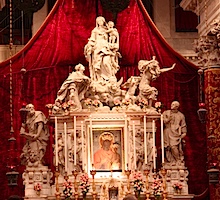
 After a group from our remiera rowed three caorline and one sandolo to the Basilica della Salute last Friday morning, we gathered for lunch at the trattoria Palazzina, located at the foot fo the Guglie Bridge. The owner is a member of our rowing club, and had the idea to offer a traditional dish associated with the Festa della Madonna della Salute, the castradina.
There were several of us — Venetian and otherwise — who’d never tasted a castradina, which made it all the more attractive, of course; I’ll try anything once. The description is daunting: a stew that’s days in preparation, consisting of a rich meat, normally obtained from Dalmatia, from an adult castrato, usually beef, in this case mutton, that’s been smoked, salted, and dried in the sun, and verze (a type of cabbage), and maybe potatoes. Sounds more German than Italian…
 It was a chilly day, and the caorlina is not a light boat to propel from the north side of the city, down the Cannaregio and Grande canals to the Salute, and back. So when we arrived at the Palazzina, we brought plenty of hunger with us. A hearty meat antipasto was served up in short order: salami feline (from near Parma, all pork, few spices, no cats), sopressa (the fattier, longer-aged Veneto salame), prosciutto, and mortadella con pistacchi…just what the doctor ordered, and frankly, what would have been enough for me.
The antipasto interchange was lively, fueled by the requisite prosecco. Once relieved of its consumed contents, the large wooden platter was whisked away, and the bowls of castradina began to appear. We peered at the first ones, and a German (married to an Italian and here for 28 years ormai) rowing companion and I made a pact that we’d take a stab at it, but if it wasn’t to our liking, say we had overdone the antipasto and leave it there. Oh, please let me like it…
My terra cotta bowl of castradina arrived, along with a basket of buttered crocanti for crunching over the top. Encouraged by the positive reactions issuing from those who’d already dug in, I did the same. The rich aroma belied nothing about the marvelous flavor: che bon! No trace of stringy, salty, smokey meat, just a flavorful stew with the vegetable and meat flavors that just hit the spot. I felt my toes warm as the rich concoction began to take effect, like some nutritious banned substance. No reactions to fake here…whew. I glanced just in time to my rowing companion polishing off the last spoonful of hers.
A grappa for the more robust among us, a caffè topped off this Salute lunch, and we all headed off back to work, restored and renewed.
Another successful research project completed.
_____________
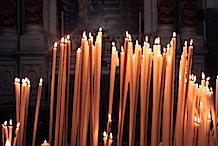
 The glorious Basilica is never more luminous than during the annual Festa della Madonna della Salute (salute means health in Italian), celebrated every November 21. Hourly masses are held, and long, white candles a blaze as prayers for health are offered. The ropes that protect the center area of the church are removed, and the front doors are open for the only time during the year.
A votive bridge is constructed across the Grand Canal at San Giglio from the night of the 20th til when it’s taken down on the following Monday. (The bridge was once supported by lashing large boats together, as the Ponte Accademia was not in place until the mid-1800s.) There are also booths with fritelle and balloons for kids, adding to the festival atmosphere.
Venice was hit by a devastating plague in 1630 that ended in 1631, following an equally devastating one just over fifty years prior (which corresponds to the Redentore festival). The Longhena Salute basilica was built in thanks to the Madonna of Good Health for ending the plague in 1631. Read Alvise Zen’s historic recount on the Comune site.
Â


